Disability, Faith & Belonging: Creating More Inclusive Churches with Nadia Ibrahim Mossburg
What does true disability inclusion look like inside our churches and faith communities? In this episode of Changing Minds & Changing Lives, Julie Sowash sits down with disability policy expert, author, and advocate Nadia Ibrahim Mossburg for a deeply personal conversation about disability, faith, accessibility, and belonging. Drawing on more than two decades of disability policy experience and her own life with cerebral palsy, Nadia explores how churches can create communities where people with disabilities are fully welcomed, valued, and included. The conversation examines the church's relationship with the Americans with Disabilities Act (ADA), the lasting impact of inaccessible spaces and attitudes, and the harmful belief that disability is something that needs to be "fixed." Nadia also shares how her faith shaped her book, Divinely Disabled: A 30-Day Devotional to Discovering God's Heart for the Disability Community, and why meaningful disability inclusion requires listening to disabled people, building relationships, and including people with disabilities throughout congregational life. Together, Julie and Nadia discuss what churches can learn from the disability community and the practical steps faith leaders and congregations can take to build greater accessibility, connection, and belonging.
In This Episode:
- Why disability inclusion and belonging remain challenges in many churches
- The history and impact of churches’ exemption from the Americans with Disabilities Act (ADA)
- Moving beyond the idea that disability is something that needs to be “fixed”
- How churches can create more accessible, welcoming faith communities
- Why listening to and learning from people with disabilities matters
- Nadia's personal journey with disability, faith, advocacy, and belonging
- How Divinely Disabled can help individuals and church leaders start meaningful conversations about disability and faith
Resources & Links:
- Divinely Disabled: A 30-Day Devotional to Discovering God's Heart for the Disability Community by Nadia Ibrahim Mossburg
- Religious Entities Under the Americans with Disabilities Act
The ADA National Network explains how the ADA applies to religious organizations, including the Title III exemption discussed in the episode. - Religious Organizations and Private Clubs Under the ADA
A deeper look at how ADA Title I and Title III apply to religious organizations.
CMCL
Nadia Mossburg
04/06/2026
Julie Sowash
Alright, welcome to the Changing Minds, Changing Lives podcast. I am your humble host, as always, Julie Sowash, CEO of Catch 22 Group, industry analyst writing at the jobboarddoctor.com, and co-founder and currently strategic advisor to the amazing team at Disability Solutions. And as we are wrapping up our most current season of Changing Minds and Changing Lives over the next month, I have to tell you that this is the guest I've been waiting for. I believe it's been at least eight months, maybe nine months, since I first asked Nadia to join us. And you all are about to find out why. But first, let's start with the number: 98% of pastors say a person with a disability would feel welcome in their church.
Yet only 31% of churches report offering actually anything for us. And nearly half of parents with kids with disabilities have left at least one church because they felt like their child wasn't wanted there. The church thinks it's welcoming. It appears that we in the community have many different experiences. And that's what I want to talk about today. My guest has spent her life in that gap. Nadia Mossburg was born with cerebral palsy.
She spent more than 20 years as a senior advisor in disability policy, working on employment, transportation, emergency management, public health at the national, state and local levels. And for over 30 years, she's led Bible studies and served inside the church she writes about.
She also knows exactly what it’s felt like to be prayed over instead of invited in. Her new book is “Divinely Disabled: a 30-Day Devotional.” Out now, I believe it came out in September, written for people with disabilities, the people who love them, and the pastors who keep saying, “We don't have any of those people here.” Nadia, welcome to the show.
Nadia Mossburg
So good to finally connect, Julie. It's been a long few months of communicating back and forth. It's so good to be here.
Julie Sowash
No, thank you so much. I spent some time over the past few days really diving into your website, your Substack, and your bio. And something that you said connected with me kind of at the heart of me. And I want to read you guys this quote: “Beyond every piece of legislation, there's a human being. When policies are crafted thoughtfully, they don't just govern, they empower.”
And I believe that's from your LinkedIn. And that just set with me because that is how we've always approached things at Disability Solutions. From how do we look at things from a systems, a technology perspective and make scalable change? And that's really what you've spent your career doing.
And it's so rare for us to be able to have someone on the show who has that deep experience in how the government works and why it's so important for us to have a functional, thoughtful bureaucracy for our community in particular. And I'm hoping if we can just start the show, if you would tell me about some of the policy work you've done over the past 20 years that you're so proud of.
Nadia Mossburg
Thank you for the opportunity. I love policy and I love, I actually love government [laughs] when it works well. Some of my proudest moments in federal work included working with state policy makers to ensure that the policies they developed were inclusive of people with disabilities. I also had the opportunity to work on emergency preparedness and emergency management just following 9/11. So for me, that was incredibly important.
As a person with a disability, as a person of Middle Eastern background, I welcomed the chance to make a positive impact in that area. And had the fortune of just working with an interagency coordinating council to develop a framework for federal agencies around emergency preparedness. So, so many wonderful things happened in the 22 years I was in federal service and I’m excited to translate that to the chat now. Disabled.
Julie Sowash
Yeah, that's amazing. I mean, that’s work that will outlive you. And that's so incredibly, so incredibly important and something to be particularly proud of. So kind of going into the church and your book, “Divinely Disabled.”
Many of you are listeners, viewers may not know, but I grew up in the the Evangelical church.
And I have been following passionately the rise of white nationalism in our churches over the, well, at least past decade. And I had a guest on my old podcast called “Crazy and the King,” who talked to me about his research on the church's failing in our community, for the disabled community in particular.
And while I was researching for our conversation today, I learned even more of the roots behind it and that it goes back to the ADA. And I want to read just a little bit of what I learned and then get your perspective on this major policy, I would say, error. You may feel differently.
But the church’s absence from the ADA was not an oversight. It wasn't an accident. In 1989, lawyers for the Association of Christian Schools International wrote the White House, arguing that accessibility was too expensive.
The government had no business in the church, and that churches were morally required to discriminate against people with HIV and Aids at the time.
The National Association of Evangelicals opposed the bill and the Coalition of Churches lobbied for a blanket exemption and they got that exemption. Thirty-six years later, that exemption still stands. So you've spent your career inside disability policy and the church as a believer and a follower.
How do you square the church's lobbying to stay out of the ADA with the belonging that you expect and your book calls for?
Nadia Mossburg
As you mentioned, I believe it was a misstep on the church's behalf. I understand the concern around the cost of accommodations and given the church’s status. Some accommodations are expensive, but the most recent data from the Job Accommodation Network shows that most accommodations cost nothing.
And for those that do cost something, they’re usually under $300 or less. And so, I believe it was a misstep. I believe it was a lack of understanding around disability and what would be necessary for people with disabilities to participate.
That being said, I think history is full of examples where the church has taken missteps.
And I think that there is an opportunity now for the church to make a change. And I believe the church has begun to make those changes. More and more churches are making efforts to include people with disabilities.
However, we are 36 years out from the ADA and I believe it's time we step up, so.
Julie Sowash
Yeah, yeah, so I guess what does, I'll put it in my church terms, what does “repentance” look like for those institutions that fought to keep us out of their congregations?
Nadia Mossburg
Repentance, to use your words, looks just like it does in any other part of repentance in the church. It means turning and going the opposite direction. And so, I believe the church has an opportunity to make both big and small changes now and to there are plenty of resources out there, plenty of ministries, plenty of opportunities for the church to demonstrate care for and in partnership with the disability community.
I think it's very important for the church to understand people with disabilities have skills and abilities to bring to the body of Christ and that the church is not whole without the presence of people with disabilities. In a sense, the church is disabled, which is ironic. [laughs]
So, I really believe it's an opportunity for the church to make a change and to open its doors wider to include people with disabilities and those families impacted by disability. It's a time for them to also listen, right?
So much of the church's history has focused on ministering to people with disabilities and those impacted by disability. I believe the church has much to learn from the disability community.
Julie Sowash
So you hit on something, I think, exactly where I was going with my next question, is, so again, having grown up in the church, this is a very personal conversation. I live with mental illness and hidden disabilities. You live with physical disabilities. And I remember always being taught this sort of mentality that God needed to fix us.
If I was more faithful, if I was less sinful, if I was whatever on that particular day, then I, then my brain would work how it is supposed to. When we had disabled people in our congregation, we prayed for God to heal them. And as a child,
I look back and I'm so embarrassed and remorseful of thinking that, you know, people needed fixed.
But that's what we were taught. And so kind of talk me through some of the the way that you approach the fixing problem within the church.
Nadia Mossburg
So for me, I had the same experience that you did, Julie. You know, I experienced people praying over me at different times. I was told if you had more faith, you’d be healed. And I think also for me, not growing up in a Christian home, I came to faith through someone sharing their faith with me.
And so for me, growing up in the family that I did, there were two topics that were off limits, right? One was faith and the other was the emotional and sort of this spiritual aspect of my disability. And so, much of what I experienced and learned about disability was along the way for me in the church.
And so, there were times where people would come up to me and pray, want to pray for me. And just through a series of conversations with pastors and church leaders over time, I really began to search the Bible and see what the Bible had to say.
And one of the verses that was particularly life changing for me was, this section in John 9 where, Jesus and the disciples encounter the man born blind. And they ask him who was born blind, “Who sinned? This man or his parents, that he was born blind?” And I love Jesus's response because there's no refuting it.
He says neither. It's so my glory may be revealed. And for me, that was life changing, because what that spoke to me was God created you this way for a purpose. Nobody made a mistake.
It wasn't that your parents did something wrong and that you were born with a disability. And so no one is to blame. God has a particular purpose for you. And He designed it from even before you were born. And so, just in searching the scripture, I have just come to believe and be reminded of God's goodness and sovereignty and of his wonderful and unique design for each of us.
And I think, you know, regardless of our disability, whether it's a physical, a mental health condition, each of our disabilities, is evidence of God's character and his creativity. And so we see the world differently.
We experience the world differently. These are all evidences of a good God who desires that his creation and know Him fully. And so in order to know Him fully, we need to have and experience Him from multiple different perspectives.
Julie Sowash
Yeah, that’s really beautifully said. And, you know, I just commend you that you've found your faith or you've kept your faith despite of the failings of sometimes the physical church, the human church, because it is an imperfect body.
You know, and one thing that we found through our work at Disability Solutions, where we work directly with employers, is that so many times an employer has no experience with disability, at least that they're aware of.
They're really scared to mess up, to fail, to do it wrong. And so I do want to give, you know, just a moment of empathy for church leaders and church members who are trying to figure out the best way forward but are not sure where to start. And so, you know, what would be your advice for A) taking the first step, but B) also not being afraid to be imperfect?
Nadia Mossburg
You know, from the church's perspective, we are all works in progress. This side of heaven, we will not be perfect. And so, from the disability community, and from the church's perspective, we all have space to grow.
And that's why I wrote “Divinely Disabled.” For me, I really wrote it as a roadmap for pastors and church leaders, even for people with disabilities wanting to step out of the mindset of something is wrong with me that needs to be fixed to I have something to contribute. And I have the courage now to approach my church leaders and say, “I want to be a part of this body and I believe I have something to contribute.”
There are reflection questions at the end of each devotional day for, as you mentioned, individuals with disabilities, the people that love them and care for them, and pastors and church leaders.
And so, a good first place to start is actually the book. Low cost, low investment. But a way to start the conversation in the church. And you're exactly right. There is an opportunity to extend grace. At the same time, extending grace does not mean doing nothing. And it also doesn't mean excusing inaction.
Julie Sowash
Yeah.
Nadia Mossburg
And so, I think we can get so caught up in needing to feel like we have the perfect ministry to reach those impacted by disability, when in fact it's really about just connection and getting to know someone. So this Sunday, sit next to someone different. Sit next to someone with a disability. Invite them into your life. Share your life with them. Ask them to pray for you. Because I guarantee you, someone with a disability knows how to pray and walk alongside those experiencing struggle and difficulty like no other group in the church. And for those of us living with disabilities, we have had to live with and wrestle with the gray. And so, I think there's much to learn from engaging with and walking alongside those with disabilities in the church.
Julie Sowash
Yeah, no. That's, again, beautifully said. And I think, I mean, if I was a congregation leader, right? I see your what you bring is a policy brain to every conversation. The ability to systemically approach, how do we include people better? How do we do more?
Nadia Mossburg
Right. I think so much of the previous approaches to disability ministry have been, let's focus on a small group of volunteers. Let's focus on a particular ministry to those with disabilities. When in fact, I believe the most effective ministries and the most effective approaches are systemic. And that includes the church.
So involving the entire congregation in a conversation around disability, in a conversation around what does it look like to endure long-term hardship or challenges or be part of any community or a group where there are those who are not accepted or those who are on the fringes? How do we welcome them in? And how do we create welcoming environments and conversations?
And so for me, although it isn't devotional, it was my attempt to say, “Let's approach this systemically.”
So it's not about a small group of pastors taking a course at a seminary. Let's involve the church, the person sitting next to you. Let's have a conversation around disability and faith.
Julie Sowash
The way that you said that, just, it reminded me of, kind of, the school system in the U.S. and kind of a post-idea world, right? So my children, me, I didn't get as much of it, but my children grew up in really, pretty fully-integrated classrooms or much more integrated classrooms than I as a student ever did.
And my children, by that nature of just being surrounded and engaged in the community as a whole and not having having people with disabilities hidden or, you know, particularly “served,” now engage with the community and have friends in the community in a way that we, I didn't have the opportunity to do. Is that kind of the same idea?
Nadia Mossburg
Absolutely. I entered kindergarten in 1975 or 6. And so, I was one of the only ones with a physical disability among my non-disabled peers.
And there was something special and unique about me being in that situation.
My peers were challenged and encouraged to engage with me in really interesting ways. And my parents fought to get me into a classroom where I could learn with my peers. And for me, that made all the difference.
From my earliest memories of school, I remember being in the classroom and just educating my peers about my things, like my startle reflex and my disability and how it impacted me. My mom would come every year, and she would speak to my classmates about what it look like to live with cerebral palsy.
And so, I think there's something to be said for someone being in the room and being at the table, so to speak, that just opens our eyes and helps us think differently like nothing else. And so, when we talk about disability and inclusion in the church, for me, an essential part of that conversation must be that people with disabilities are part of every part of church life from Sunday to Sunday.
And so, I really see it as an open door, for friendships and relationships to develop. There's something to be said for spending time with someone outside of Sundays and understanding their life and the challenges they face whether they have a disability or not. And I think it helps us. It makes us more compassionate, more aware.
I can't tell you how many friends I have that don't have disabilities, but have said to me, “I didn't think about this until we went out and I saw the inaccessible parking spaces, the inaccessible doorways, the lack of ramps and elevators.”
And it frustrates me. These are my friends without disabilities. And so, I think it's how we develop awareness, compassion and empathy, but also how we learn to take action, right? Because my friends have taken action because they want to spend time with me.
They want me to be part of what they're doing. And so, I think it makes all the difference to have someone with a disability engaged and involved in congregational life.
Julie Sowash
Yeah, absolutely. So as we kind of wrap up here, I was reading your Substack this morning, and I read that you and your husband, Matthew, have recently made the decision to step away from your current church body. Do you mind sharing a little bit of that journey with our listeners so they can kind of hear one-to-one what that was like for you?
Nadia Mossburg
It's not a decision that we make lightly. We've been there for a few months. We recently moved to Nashville. So earlier this year, we made the decision to attend the church, and we actually had a conversation with the pastor at the church within a few weeks of being there, because I experienced a conversation that just made me uncomfortable around disability or hardship and God's sovereignty.
And so I wanted to have a one-on-one conversation with the pastor around what does the church believe? Following that conversation, changes were made and things were done. But then, I've also experienced some health issues recently. And there was a lack of response from leadership in the church. As I was in the hospital and such.
And so, I just after prayer and consideration, my husband and I made the decision to let the church know that we would not be pursuing membership. I will tell you that the pastor has reached out and we're in conversation.
And so I have an opportunity to share directly why it's so important to me. It's not just about the pastor calling me and apologizing and praying with me. And although I appreciate that, for me, there are bigger issues at stake, right?
It's about the church reflecting the heart of God. And so, there is an opportunity for the church to make changes. And I'm hopeful that they will do that. But I think sometimes even when we advocate and even when there is change, sometimes, for our own mental health and wellbeing, we need to find a place where there isn't that history. And so,
Julie Sowash
Yeah.
Nadia Mossburg
we are in the midst of talking that out with church leadership. And I want to respect their privacy and their willingness to have that conversation.
But a lot of what I've been writing is borne out of that personal experience. And so, just even thinking through for myself, you know, do I say something? Do I not say something?
Am I gonna be perceived as a complainer and ungrateful? And, you know, I've had many conversations with Matthew, my husband, and friends. And at the end of the day, it's not a sort of a gotcha situation for me.
I'm not looking to embarrass or sort of put someone on the spot. What the heart of it for me is to say there were missed opportunities here. And I don't want the people after me to experience the same thing, because I believe God desires more for His church.
You know, the Scripture says, that God is a jealous God. And I didn't really understand that until getting a service dog. And part of getting my first service dog many years ago, I had to learn sort of the experience of people would ask if they could pet Tulles, my first service dog.
And initially, I thought, this is a great opportunity to engage with people, for them to learn about service dogs. And then I realized I'm not doing myself any favors by allowing anybody and everybody to pet my service dog.
And so I became jealous for my service dog, meaning that I knew what he was capable of. And I knew that having people pet him would distract him from his ultimate purpose and what made him the most happy, which was serving me and following me and doing what I needed to be independent.
And so I think God is a jealous God, and He desires more from his people, not out of harshness, but out of love. To say, “I've made you for more. I've designed you for more. I want you to reflect me fully.” And this is one way to do that. Does that make sense?
Julie Sowash
It does. And yes I know all about a jealous God. We, that was something we grew up talking about quite a bit. And I like the way that you put that. It just really is a different perspective on how to think about your personal relationship with God and your personal relationship with the church.
And I really respect the fact that you can recognize that while the church that you’re currently attending may be able to fix things in the future, and that's your hope and desire, for you, the right answer may be to find a new body to be a part of. And I think that we can say that we, you know, you can forgive and educate and move on, but that doesn't mean you're required to stay in that same situation.
Nadia Mossburg
Absolutely. And I think that that is important to remember. There's nothing wrong with making a thoughtful decision to worship elsewhere and to find a community where you feel welcome, loved, accepted and valued as a contributing member. And so, yeah, I love what you said just about sending forgiveness, but also knowing when it's time to move on.
Julie Sowash
Yeah.
Nadia Mossburg
That's absolutely true.
Julie Sowash
So, Nadia, where can people connect with you? Where can they find the book and start their own devotional journey?
Nadia Mossburg
They can connect with me on my website www.divinelydisabled.com. There are links to purchase the devotional. And there are ways to connect with me on the website as well. And I would love to connect with anyone who’d like to have a conversation around this topic. Thank you so much, Julie.
Julie Sowash
Thank you for joining us. Guys, I'm sure that you were as educated and enthralled with this story as I have been. I'm so glad that we finally got Nadia on the show. Catch out some of our past episodes. We've got a couple more coming up for the rest of the year. But until next time, keep changing minds and changing lives. Bye.
Author and speaker
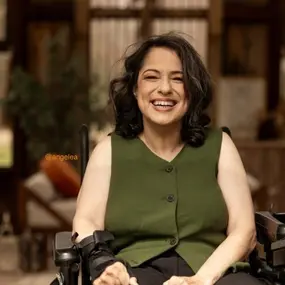
Nadia Ibrahim Mossburg, born with cerebral palsy, uses her degrees in English, journalism, and social work, as well as her experience as a senior advisor in disability policy, to improve disability policy at the national, state, and local levels. For over two decades, she has advocated for greater equity, better employment, emergency management, public health, and public transportation. Over more than three decades, she has also led Bible studies and served on many teams at her church. Nadia and her husband, Mathew, live in the Nashville area with their three cats and Watson, Nadia’s third service dog, who is enjoying retirement.